A/B test our recommendations against yours.
Pay only if we win.
A/B test our recommendations against yours.
Pay only if we win.
Bytem's recommendation is built for fashion only. The test is free, runs on the metric you choose, and you pay only once you accept the result.
Bytem's recommendation is built for fashion only. The test is free, runs on the metric you choose, and you pay only once you accept the result.

Revenue Lift
29.98%
A US fashion store
vs. their existing engine
30-day A/B test
Source: their own analytics
W1
W2
W3
W4
W5
W6
W7
Revenue Lift
29.98%
A US fashion store
vs. their existing engine
30-day A/B test
Source: their own analytics
W1
W2
W3
W4
W5
W6
W7
Revenue Lift
29.98%
A US fashion store
vs. their existing engine
30-day A/B test
Source: their own analytics
W1
W2
W3
W4
W5
W6
W7









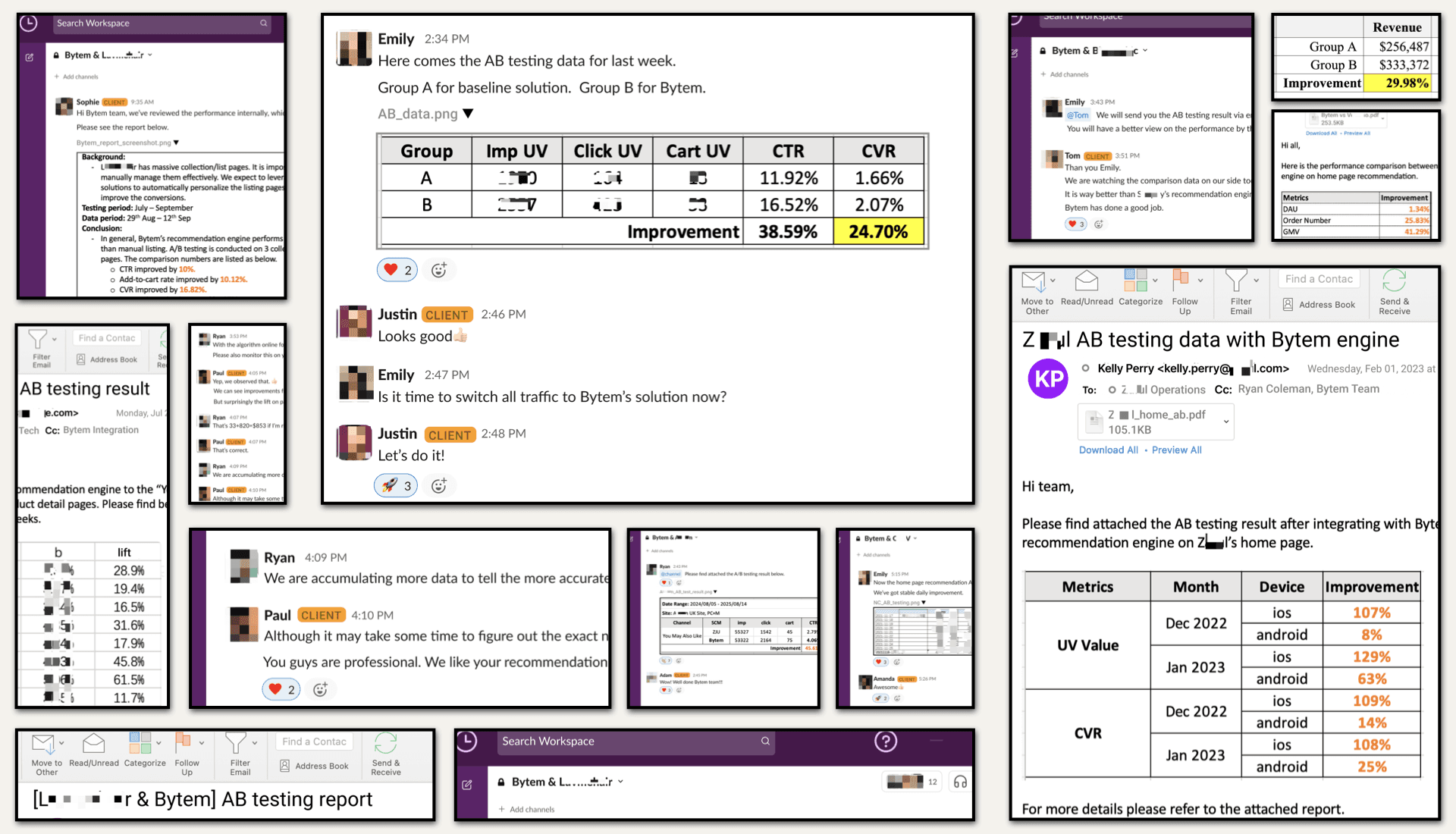
Screenshots from client Slack channels and email threads. Names redacted.
Screenshots from client Slack channels and email threads. Names redacted.
Everyone else sells you features. We sell you results.
Most recommendation platforms sell you a stack of features. We'd rather be judged on results you can check yourself.
Recommendations with real lift
Merchandising that hits your targets
Results you can audit

Recommendations with real lift
Most recommendation widgets were built to sell iPads, vacuums and and dog food — not dresses.
A shopper is looking at a USB-C charger, and you show her other USB-C chargers. That logic works. But when she's drawn to a dress because it makes her feel sexy and ready to go out, and you show her a sweet, ladylike dress just because both are tagged "nylon" and "dress" — that's what the "You may also like" feature gets you. It hasn't lifted your sales at all.
It's not a one-off: "Frequently bought together" works for functional products — buy an iPad, and a case is the obvious add-on. But fashion pairs by look, not function. "Recommended for you" barely works on new arrivals with no click history, and every season brings a wave of new styles.
Recommendations with real lift
Merchandising that hits your targets
Results you can audit
Recommendations with real lift
Most recommendation widgets were built to sell iPads, vacuums and and dog food — not dresses.
A shopper is looking at a USB-C charger, and you show her other USB-C chargers. That logic works. But when she's drawn to a dress because it makes her feel sexy and ready to go out, and you show her a sweet, ladylike dress just because both are tagged "nylon" and "dress" — that's what the "You may also like" feature gets you. It hasn't lifted your sales at all.
It's not a one-off: "Frequently bought together" works for functional products — buy an iPad, and a case is the obvious add-on. But fashion pairs by look, not function. "Recommended for you" barely works on new arrivals with no click history, and every season brings a wave of new styles.
So what actually makes recommendations sell more?
A model that reads fashion, not just clicks. A model tuned to your store, not shipped with defaults. And a fashion experts who owns the result after launch.
Built for fashion only
Agentic AI, run by experts
Tuned until sales lift

Built for fashion only
One model for iPads and dresses? Not ours.
One model rarely works for every category. Fashion has seasons; electronics barely do. In fashion, the product photo can make the sale. For most functional products, it hardly matters.
So we gave up every other category and trained a model just for fashion shoppers. It reads a garment's style and vibe, so it recommends pieces with the same look — not pieces that do the same job. It also knows how fashion shoppers browse, so it knows when to personalize and when to show similar styles or pieces to pair.
Each of these is a "feature" that has held up across hundreds of fashion stores. Actually, we call them model weights and strategies. We don't sell features.
Built for fashion only
Agentic AI, run by experts
Tuned until sales lift
Built for fashion only
One model for iPads and dresses? Not ours.
One model rarely works for every category. Fashion has seasons; electronics barely do. In fashion, the product photo can make the sale. For most functional products, it hardly matters.
So we gave up every other category and trained a model just for fashion shoppers. It reads a garment's style and vibe, so it recommends pieces with the same look — not pieces that do the same job. It also knows how fashion shoppers browse, so it knows when to personalize and when to show similar styles or pieces to pair.
Each of these is a "feature" that has held up across hundreds of fashion stores. Actually, we call them model weights and strategies. We don't sell features.
Works with the stack you already have
Bytem sits on top of your store. You keep your theme, your checkout, your analytics. Nothing about how you run the site changes.
Works with the stack you already have
Bytem sits on top of your store. You keep your theme, your checkout, your analytics. Nothing about how you run the site changes.
✔
Works with Shopify Plus, Wix, Magento and more.
✔
One API puts recommendations on any page in your website or app.
✔
Also in your email, SMS and push.








01
Add one script
One JS snippet in your site's <head>. We match the widgets to your theme, and nothing goes live until you approve it.


02
Send us your product feed
We use the product feed you already send to Google or Meta. No new data work for your team.
03
Read the report
The A/B test starts the day we go live. About 4 weeks later, you get the report: what we added.
01
Add one script
One JS snippet in your site's <head>. We match the widgets to your theme, and nothing goes live until you approve it.
02
Send us your product feed
We use the product feed you already send to Google or Meta. No new data work for your team.

03
Read the report
The A/B test starts the day we go live. About 4 weeks later, you get the report: what we added.
01
Add one script
One JS snippet in your site's <head>. We match the widgets to your theme, and nothing goes live until you approve it.
02
Send us your product feed
We use the product feed you already send to Google or Meta. No new data work for your team.
03
Read the report
The A/B test starts the day we go live. About 4 weeks later, you get the report: what we added.

Flexible pricing
Starter
For early-stage teams
Growth
Most popular
Scale
For fast-scaling starups



4.9 / 5 Rated
Over 9.2k Customers
Starter
$24
/ mo
Ideal for early-stage teams who need actionable insights to move forward.
Access to core features
Basic performance reporting
Email support
Strategy onboarding guide
Monthly check-in summary
Flexible pricing
Simple, transparent pricing with no hidden fees.
Starter
For early-stage teams
Growth
Most popular
Scale
For fast-scaling starups
Starter
$24
/ mo
Ideal for early-stage teams who need actionable insights to move forward.
Access to core features
Basic performance reporting
Email support
Strategy onboarding guide
Monthly check-in summary
4.9 / 5 Rated
Over 9.2k Customers
Flexible pricing
Simple, transparent pricing with no hidden fees.
Starter
For early-stage teams
Growth
Most popular
Scale
For fast-scaling starups
Starter
$24
/ mo
Ideal for early-stage teams who need actionable insights to move forward.
Access to core features
Basic performance reporting
Email support
Strategy onboarding guide
Monthly check-in summary
4.9 / 5 Rated
Over 9.2k Customers
My CEO called and asked what Bytem was actually adding. I said about 20%. He asked if I was sure, so I sent him the A/B report. We have not looked at another recommendation vendor since — this is year five.
Leon Carter
Director of Ecommerce at ChicPoint

I have never had to explain product lifecycle or MOQ to a recommendation vendor before. They came in with a formula for how many impressions a new arrival should get on day one — I had been setting that number by gut for six years. Then the A/B test told me what it was worth.
Olivia Smith
Site Merchandising at MARKAVIP

It has been a tight year. We cut Facebook spend by 60% and dropped most of the software we thought we needed. Bytem was never on that list — the A/B report puts it in the revenue column, not the cost column.
Aaron Davis
CEO & Founder at Jollychic

Your questions, answered
Get quick answers to the most common questions about our platform and services.
Your questions, answered
Get quick answers to the most common questions about our platform and services.
How do you know the lift is real and not just a good month?
Because we do not measure it in a dashboard. From the day the model goes live your traffic is split: one group sees Bytem's recommendations, the other sees what you had before. Both groups live through the same season, the same promotions, the same product going viral on TikTok. The difference between the two groups is the only thing we take credit for. You agree on the metric and the split before the test starts, and you can read it in your own analytics rather than ours.
What if the test shows no lift?
It happens, and more often than you'd expect: more than 30% of our launches show no lift at first. Usually it's one of three things: a tracking event firing wrong, model weights that don't match how your store sells, or an engine you already run that's hard to beat. We tell you which one it was and keep tuning. The test itself is free. You choose the metric, and a test usually runs 30 days. If there's still no lift after 30 days, we can agree to run another 30. You don't pay anything until you accept the result.
Can I check the results in my own analytics?
Yes. We can push the test data into your Google Analytics, so the result sits next to the rest of your reports. If you already have your own tracking, you can measure the test with it yourself.
How is this different from the recommendation app already on my store?
Two things. Most apps are built to work for every category, which means they are tuned for none. We build for fashion only, because fashion shoppers behave differently: style is subjective where function is objective, seasons matter, and the product image carries much of the decision. The second difference is what you get at the end. An app hands you a dashboard. We hand you a controlled test result. If you want to know which of us is better on your store, the honest answer is that we should run the test.
What data do you need, and where does it live?
Two things: a lightweight pixel on your storefront that records browsing and purchase events, and your product feed. We do not need customer names, email addresses or payment details. Your data is never mixed into another client's model.
Which platforms do you support?
Shopify, Shopify Plus, SHOPLINE, Magento and most other major ecommerce platforms. On any of them, setup is one JavaScript snippet in your site's head. Running a custom or headless storefront? Connect through our API instead.
How do you know the lift is real and not just a good month?
Because we do not measure it in a dashboard. From the day the model goes live your traffic is split: one group sees Bytem's recommendations, the other sees what you had before. Both groups live through the same season, the same promotions, the same product going viral on TikTok. The difference between the two groups is the only thing we take credit for. You agree on the metric and the split before the test starts, and you can read it in your own analytics rather than ours.
What if the test shows no lift?
It happens, and more often than you'd expect: more than 30% of our launches show no lift at first. Usually it's one of three things: a tracking event firing wrong, model weights that don't match how your store sells, or an engine you already run that's hard to beat. We tell you which one it was and keep tuning. The test itself is free. You choose the metric, and a test usually runs 30 days. If there's still no lift after 30 days, we can agree to run another 30. You don't pay anything until you accept the result.
Can I check the results in my own analytics?
Yes. We can push the test data into your Google Analytics, so the result sits next to the rest of your reports. If you already have your own tracking, you can measure the test with it yourself.
How is this different from the recommendation app already on my store?
Two things. Most apps are built to work for every category, which means they are tuned for none. We build for fashion only, because fashion shoppers behave differently: style is subjective where function is objective, seasons matter, and the product image carries much of the decision. The second difference is what you get at the end. An app hands you a dashboard. We hand you a controlled test result. If you want to know which of us is better on your store, the honest answer is that we should run the test.
What data do you need, and where does it live?
Two things: a lightweight pixel on your storefront that records browsing and purchase events, and your product feed. We do not need customer names, email addresses or payment details. Your data is never mixed into another client's model.
Which platforms do you support?
Shopify, Shopify Plus, SHOPLINE, Magento and most other major ecommerce platforms. On any of them, setup is one JavaScript snippet in your site's head. Running a custom or headless storefront? Connect through our API instead.

Start your journey
Let’s start building something great together.
Start your journey
Let’s start building something great together.
206-837-1232
hello@grovia.io
4.9 / 5 Rated
Over 9.2k Customers
Start your journey
Let’s start building something great together.
206-837-1232
hello@grovia.io
4.9 / 5 Rated
Over 9.2k Customers